Geometry of SQFA
In this tutorial we provide a brief overview of the geometric perspective of SQFA and smSQFA. We start by explaining what is supervised linear dimensionality reduction. Then, we explain how SQFA and smSQFA use a geometric perspective on discriminability to learn discriminative linear features.
SQFA and smSQFA perform supervised dimensionality reduction
Supervised linear dimensionality reduction is a class of methods that use the class labels of the data to learn a set of linear features that are useful for classification.
More specifically, given a dataset \(\{\mathbf{x}_t, y_t\}_{t=1}^N\) where \(\mathbf{x}_t \in \mathbb{R}^n\) are the data vectors, \(y_t \in \{1, \ldots, c}\) are the class labels, the goal of supervised linear dimensionality reduction in general is to learn a set of linear filters \(\mathbf{F} \in \mathbb{R}^{n \times m}\), \(m<n\) such that the transformed data points \(\mathbf{z}_t = \mathbf{F}^T \mathbf{x}_t\) support classification as best as possible.
The classical example of supervised dimensionality reduction is Linear Discriminant Analysis (LDA). LDA aims to maximize linear discriminability. For this, LDA uses the class-conditional means \(\mu_i = \mathbb{E}[\mathbf{z} | y=i]\) and the residual covariance matrix \(\Sigma\), where it is assumed that all classes have the same covariance matrix. Then, LDA learns a set of linear filters \(\mathbf{F} \in \mathbb{R}^{n \times m}\) that maximizes the spread between the class means (or their distances) relative to the covariance of the data in the feature space. For this goal, LDA quantifies the spread between class means using the Mahalanobis distance, which is just the Euclidean distance after transforming the data to have \(\Sigma = \mathbf{I}_m\), where \(\mathbf{I}_m\) is the \(m \times m\) identity matrix.
The goal of SQFA and smSQFA is similar to LDA. What characterizes SQFA and smSQFA, however, is that they take into account the class-specific second-order statistics to make the classes discriminable. Specifically, SQFA uses both the class-conditional means \(\mu_i\) and the class-conditional covariance matrices \(\Sima_i\) of the features, and smSQFA uses only the class-conditional second-moment matrices \(\Psi_i = \mathbb{E}[\mathbf{z}\mathbf{z}^T | y=i]\). Then, SQFA and smSQFA learn the filters that make the classes as different as possible considering their second-order statistics. Such differences in second-order statistics are particularly useful for quadratic classifiers, such as QDA.
But how can we quantify how different two classes are with respect to their second-order statistics, in a way that is useful for classification? SQFA and smSQFA take a geometric perspective to answer this question. To explain this, we first take a detour into the geometry of symmetric positive definite (SPD) matrices, and then use this geometry to explain smSQFA, which is the simpler of the two methods.
The geometric perspective of smSQFA
Riemannian manifolds
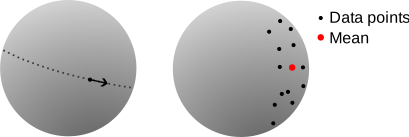
Riemannian manifolds are geometric spaces that locally look like Euclidean spaces, but globally can have a more complex structure. The classical example of a Riemannian manifold is the surface of a sphere. Locally, if we zoom in enough the sphere looks like an Euclidean plane, but globally it is not an Euclidean plane, as illustrated by the fact that we can follow a “straight trajectory” and come back to the same point.
Riemannian geometry provides the tools to do usual geometric operations in such spaces, like measuring distances, interpolating, finding averages, etc.
Symmetric Positive Definite (SPD) matrices are symmetric matrices whose eigenvalues are all strictly positive. This type of matrix appears in many statistics and machine learning applications. For example, covariance matrices and second-moment matrices are SPD matrices[1]. The set of \(m\)-by\(m\) SPD matrices forms a manifold, denoted \(\mathrm{SPD(m)}\). The geometry of \(\mathrm{SPD(m)}\) (which is shaped like an open cone in the space of symmetric matrices) is very well studied, and there are different formulas for computing distances, geodesics, means, and other geometric quantities in this space.
As mentioned above, smSQFA focuses on maximizing the discriminability allowed by the class-conditional second-moment matrices \(\Psi_i\). For this, smSQFA considers the second-moment matrices \(\Psi_i\) as points in the SPD manifold \(\mathrm{SPD(m)}\).
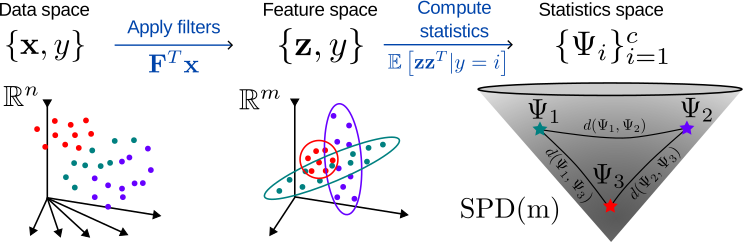
What is the advantage of considering the second-moment matrices as points in \(\mathrm{SPD(m)}\)? The key idea is that when matrices \(\Psi_i\) and \(\Psi_j\) are farther apart in \(\mathrm{SPD(m)}\), they are more different, and thus more discriminable. Therefore, smSQFA maximizes the distances between the second-moment matrices in \(\mathrm{SPD(m)}\). This is analogous to how LDA maximizes the distances between the class means in Euclidean space[2]. The objective of smSQFA can be written as
\(U\left(\left\{\Psi_i\right\}_{i=1}^{i=q}\right) = \sum_{i=1}^{c}\sum_{j=1}^{c} d(\Psi_i,\Psi_j),\)
where \(d(\Psi_i,\Psi_j)\) is the Riemannian distance between the second-moment matrices \(\Psi_i\) and \(\Psi_j\), and \(c\) is the number of classes. More specifically, out of the many distances that can be defined in \(\mathrm{SPD(m)}\), smSQFA uses the affine-invariant Riemannian distance, which is related to quadratic discriminability. The affine invariance distance is given by
\(d(\Psi_i,\Psi_j) = \left\| \log(\Psi_i^{-1/2}\Psi_j\Psi_i^{-1/2}) \right\|_F = \sum_{k=1}^{m} \log^2(\lambda_k),\)
where \(\log\) is the matrix logarithm, \(\|\cdot\|_F\) is the Frobenius norm, and where \(\lambda_k\) are the eigenvalues of \(\Psi_i^{-1/2}\Psi_j\Psi_i^{-1/2}\), or equivalently, the generalized eigenvalues of the pair \((\Psi_i, \Psi_j)\).
The relationship between the affine-invariant distance and quadratic discriminability is discussed at length in the SQFA paper. With this geometric approach, smSQFA learns filters that allow for quadratic discriminability, as shown with different examples in the documentation tutorials.
SQFA input types: Raw data vs statistics
Note that in order to compute the class-conditional means,
covariances, and second-moment matrices of the features, we
only need these statistics for the raw data \(\mathbf{x}_t\).
For example, the second-moment matrix \(\Psi_i\) can be computed
as \(\Psi_i = F^T \mathbb{E}[\mathbf{x}\mathbf{x}^T |y=i] F\).
Thus, SQFA only needs the class-conditional statistics of the raw data
for learning the filters. The sqfa package models can
take either the raw data or the data statistics as input.
Using first- and second-order statistics
We have presented the example of smSQFA, which maximizes the discriminability based on the second-moment matrices of the features. However, second-moment matrices are less informative than considering both the means and the covariance matrices of the features simultaneously. SQFA considers both the class-conditional means and covariances.
SQFA uses the same geometric perspective as smSQFA, but using a different manifold that accounts for both means and covariances. This is the information-geometry manifold of \(m\)-dimensional Gaussian distributions, denoted \(\mathcal{M}_{\mathcal{N}}\), where each point corresponds to a Gaussian distribution \(\mathcal{N}(\mu, \Sigma)\). SQFA uses the Fisher-Rao distance to measure the distances between the classes. Like in the previous case, SQFA computes the means \(\mu_i\) and covariance matrices \(\Sigma_i\) of the features for each class, and then it computes the Fisher-Rao distance between the Gaussian distributions \(\mathcal{N}(\mu_i, \Sigma_i)\) and \(\mathcal{N}(\mu_j, \Sigma_j)\). SQFA finds the linear filters \(\mathbf{F}\) that maximize the sum of the pairwise Fisher-Rao distances between the classes. The link between the Fisher-Rao distance and quadratic discriminability is discussed in the SQFA paper.
LDA is a special case of SQFA
In the SQFA paper we show that LDA is a special case of SQFA when all the classes have the same covariance matrix. That is, when all the classes have the same covariance matrix, LDA maximizes the sum of pairwise Fisher-Rao distances between the classes.
One important final detail to note is that, unlike the affine-invariant distance, there is no closed-form expression for the Fisher-Rao distance between two Gaussians. Thus, SQFA uses an approximation. This approximation, sometimes called the Calvo-Oller approximation, is a lower bound obtained by embedding the means and covariances into the \(\mathrm{SPD(m+1)}\) manifold, and then computing the affine-invariant distance between the embeddings. More detail is given in the SQFA paper.
In summary, SQFA and smSQFA leverage information geometry
to learn discriminative features by that maximizing the distances
between the class statistics. In the next tutorials we will learn
how to use the sqfa package, and how the features learned by
SQFA and smSQFA compare to other methods.